OFFERING
AI Engineering & Intelligent Systems
Apply AI where it can improve how work is done, decisions are made and knowledge is used.
Ghosh Intelligence works with businesses that want to move from AI interest to practical implementation. The work can begin with a workflow that needs redesign, a knowledge problem, a repetitive decision process or an opportunity to introduce agents, RAG or tool-enabled applications into existing operations.
The focus is on building useful systems around real business needs, with attention to workflow design, context, human review, system boundaries and the way people will actually use the technology.
WHAT THE WORK COVERS
From AI use case to working system.
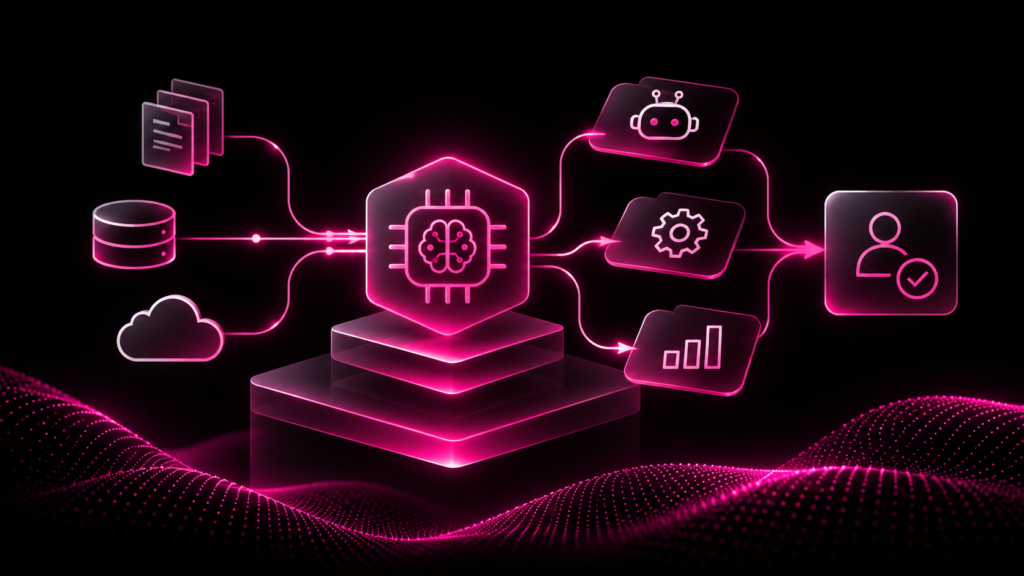
AI becomes useful when the technical design fits the way work actually happens. The focus is therefore not only on models, but on the workflows, knowledge, tools, controls and human judgement around them.
Ghosh Intelligence can support individual AI initiatives or broader intelligent-system development across six areas.
01
Workflow and process design
Identifying where AI can reduce friction, support decisions or change how work is carried out, then designing the workflow around that opportunity.
02
Agentic systems
Designing systems in which AI agents can interpret context, use tools, coordinate tasks and operate within defined boundaries and review points.
03
RAG and knowledge workflows
Building retrieval and knowledge flows that help AI systems access relevant business information, preserve context and support more grounded responses or actions.
04
Tool-enabled applications
Connecting AI with the applications, services and data sources required to complete useful work rather than limiting it to standalone generation.
05
Human review and control
Defining where people need to review, approve, intervene or override system behaviour, particularly where decisions carry operational or commercial consequences.
06
Technical capability-building
Helping teams understand how AI systems work in practice so they can make better implementation decisions, operate them more effectively and develop internal capability over time.
TYPICAL QUESTIONS WE HELP ANSWER
The question is not whether AI can be used, but where it should be used.
The work usually begins by identifying where AI can improve a real process, decision or knowledge task, and what needs to be designed around it for the system to be useful in practice.
01
Which workflows are actually worth applying AI to?
Identifying processes where AI can reduce friction, support judgement, improve access to information or automate parts of the work without creating unnecessary complexity.
02
Should this use case rely on an agent, RAG or a simpler workflow?
Assessing the task, information requirements, tool access and decision boundaries to determine which technical approach is appropriate rather than defaulting to the most complex option.
03
How should the system access business knowledge?
Determining what information the system needs, where that information lives and how retrieval, context and knowledge flows should be structured to support useful outputs.
04
What should the AI be allowed to do on its own?
Defining system boundaries, tool access, approvals, human review and escalation points so that automation remains proportionate to the consequences of the task.
05
How do we connect AI to the tools people already use?
Designing the interaction between AI, applications, APIs, data sources and existing workflows so that the system can support real work rather than operate as an isolated interface.
06
What needs to change for the system to work in practice?
Examining workflow design, user behaviour, operating responsibilities, technical capability and review processes to identify what needs to be in place around the technology.
ENGAGEMENTS & DELIVERABLES
Useful AI starts with a system that fits the work.
The engagement can focus on one workflow, knowledge problem or application, or extend across the design of a broader intelligent system. The scope depends on what the system needs to understand, which tools it must use, where people remain involved and what outcome the business expects.
AI workflow design
A defined workflow showing where AI should contribute, what information it needs, which decisions remain human-led and how the process should operate from input to outcome.
Agentic system design
A practical design for agents that need to interpret context, perform tasks, use tools or coordinate work within clear operating boundaries.
RAG and knowledge-system design
A structured approach to how business knowledge is sourced, retrieved and presented to AI systems so that relevant context is available when it is needed.
Tool and application integration
Design and implementation of the connections required for AI systems to interact with business applications, APIs, services and data sources.
Human review and control framework
Defined approval, review, intervention and escalation points for workflows where AI-generated decisions or actions require human judgement or oversight.
AI implementation prototype
A focused working implementation used to test a use case, workflow or system design before committing to a broader production build.
FROM BUSINESS NEED TO WORKING AI
The technology comes after the problem is clear.
The exact path depends on the use case, but the work generally moves through four stages.
Define what the system needs to accomplish
Start with the workflow, decision or knowledge task rather than the technology. Clarify the intended outcome, the people involved, the information required and where the current process is creating friction.

Design the system around the work
Determine how AI, knowledge, tools and existing applications should interact, including what the system can do independently and where human judgement needs to remain.
Build and test the working flow
Develop the workflow or prototype, connect the required components and test how the system performs with realistic inputs, tasks and operating conditions.
Refine for practical use
Use what the testing reveals to improve the workflow, controls and user interaction, and identify what needs to be in place before the system is used more broadly.
DISCUSS YOUR AI USE CASE
Start with the work the system needs to improve.
If you are exploring an AI workflow, agentic system, RAG application or tool-enabled process, we can begin with the business need and determine what kind of system, controls and implementation approach make sense.